Eigenvectors
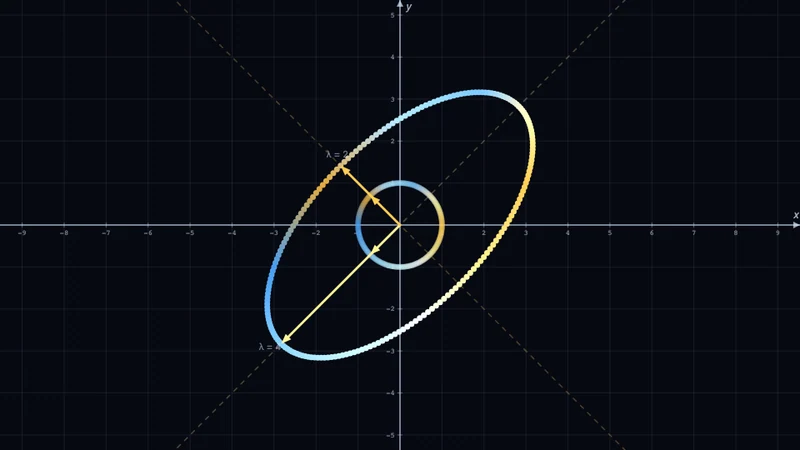
A·v = λ·v — the unit circle becomes an ellipse, eigenvectors are its principal axes. Interactive vector, exact eigenvalue computation, every special case: real, complex, defective, singular.
Linear algebraTry itVisuApps
Grasp matrices, vectors and linear maps interactively
Apps
A·v = λ·v — the unit circle becomes an ellipse, eigenvectors are its principal axes. Interactive vector, exact eigenvalue computation, every special case: real, complex, defective, singular.
Linear algebraTry it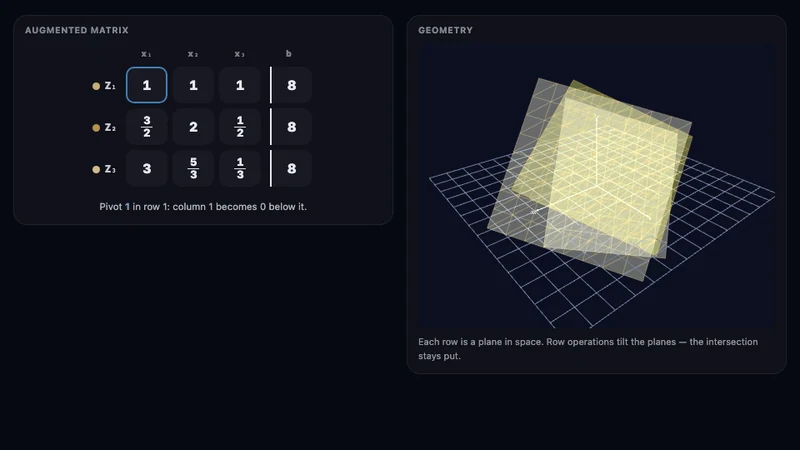
Perform row operations with exact fractions, reach echelon form and back-substitute. Explore unique, absent or infinitely many solutions, matrix inverses and intersecting planes.
Linear algebraTry it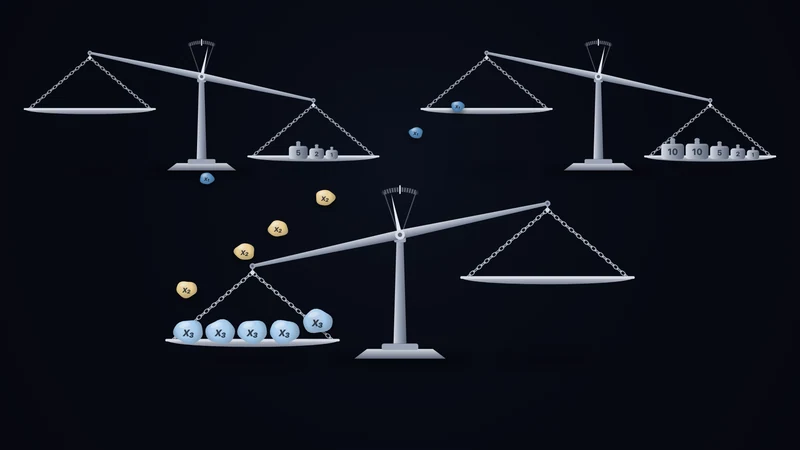
Equations as beam balances: add two scales and knock out an unknown with Gauss – coloured stones against metal weights.
Linear algebraTry it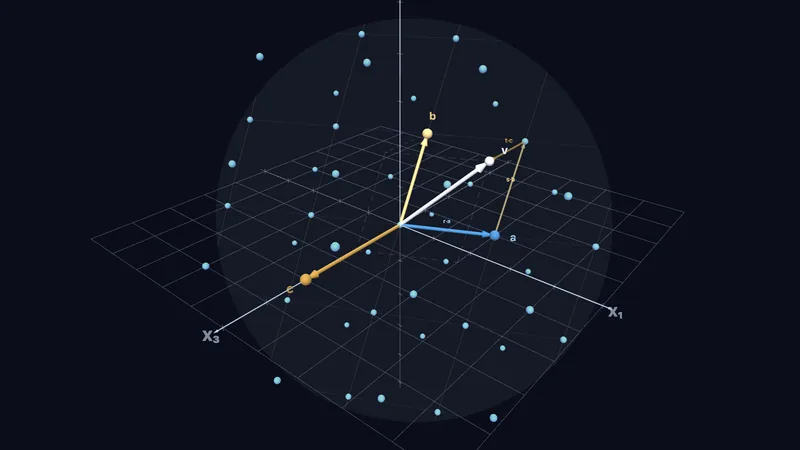
r·a + s·b + t·c as a vector chain: the span is a line, a plane or all of space. Moving c into the plane of a and b collapses the space grid to a plane, det = 0 and a non-trivial zero chain appears. Decomposition mode F = r·a + s·b, graphically via the parallelogram and as a linear system.
Linear algebraTry it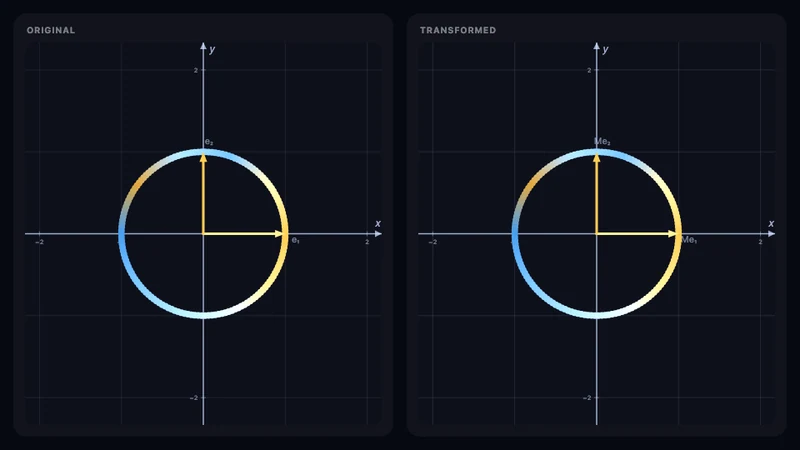
How a 2×2 or 3×3 matrix deforms space — point clouds, grid distortion and basis vectors in split-screen (2D + 3D).
Linear algebraTry it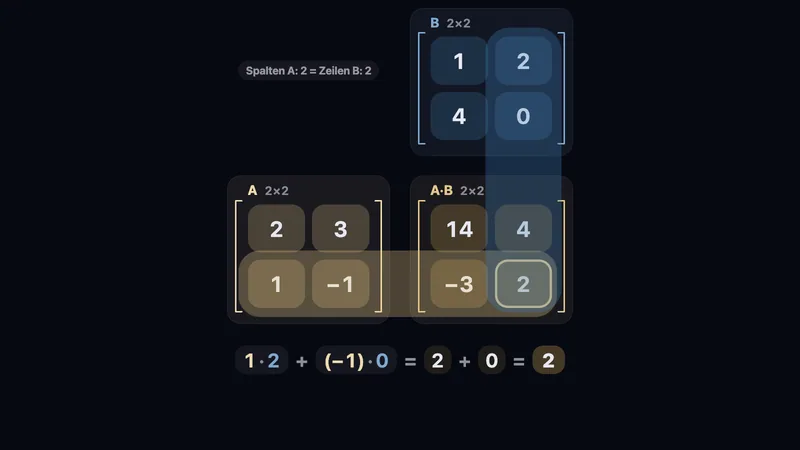
Matrizenrechnung Schritt für Schritt animiert: A·B als Zeile mal Spalte, wahlweise im Falk-Schema, mit Tausch A·B ↔ B·A; die Inverse über (A | E) mit Gauß-Jordan und exakten Brüchen; die Transponierte als Spiegelung an der Hauptdiagonale.
Linear algebraTry it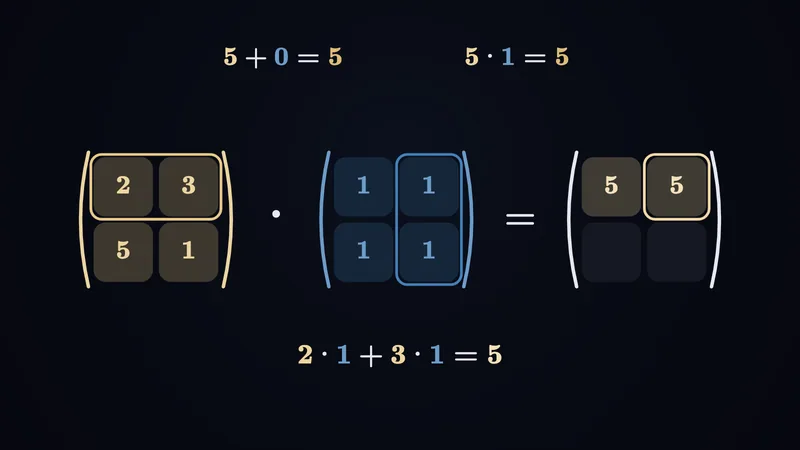
Who plays the role of 0 and 1 for matrices? The zero matrix for plus, the identity for times, not the matrix full of ones: (2 3; 5 1) times the all-ones matrix gives (5 5; 6 6). Opposite matrix and inverse as reciprocal, A·x = b unfolds into three equations, x = A⁻¹·b, Gauss-Jordan on (A | I) and the phone matrix 1 to 9, which has no inverse (0 = 2).
Linear algebraTry it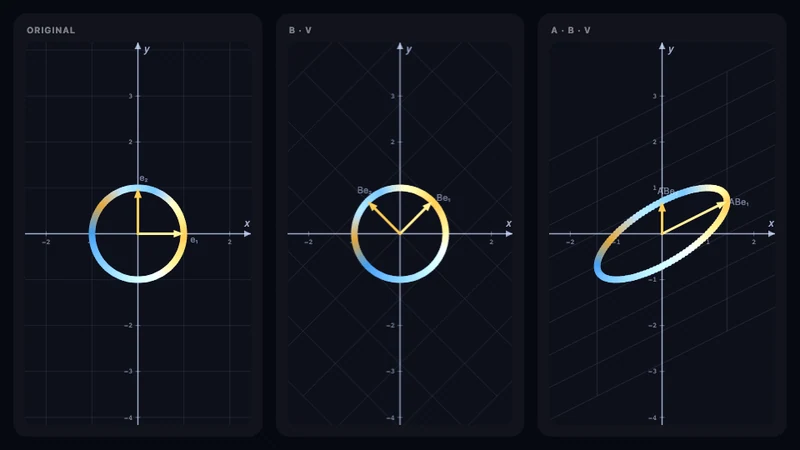
A·B as composition: three columns Original | B·v | A·B·v show how two linear maps are chained — with a swap button for A·B ≠ B·A.
Linear algebraTry it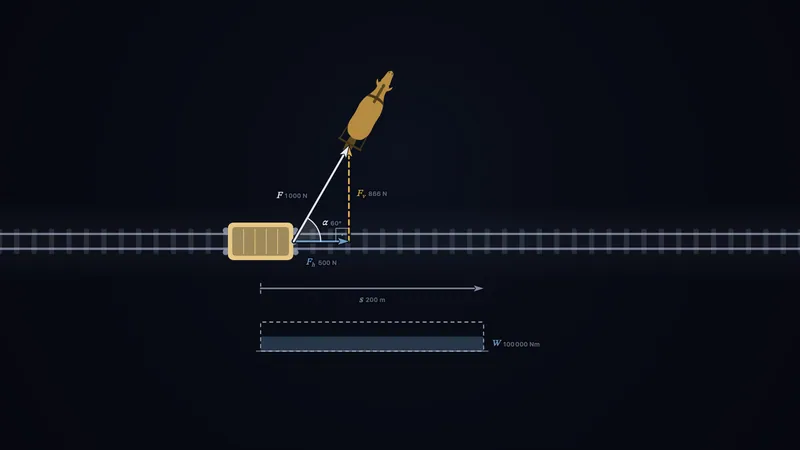
A horse pulls a wagon at an angle α: the force splits into a part along the rail that does work and a perpendicular part that is lost. W = |F| · |s| · cos α; at 90° the wagon stands still. This gives the dot product F · s.
Linear algebraTry it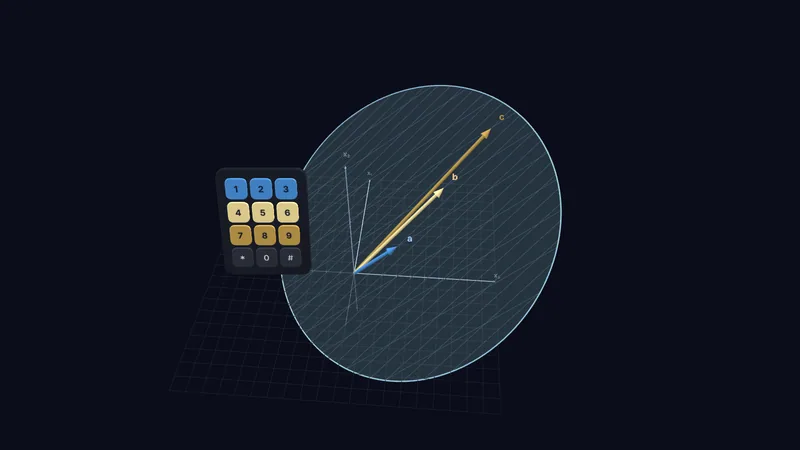
The keypad rows 1-2-3, 4-5-6, 7-8-9 as vectors in space: the game of the closed vector chain finds a − 2b + c = 0, so they are linearly dependent and lie in one plane. Seen edge-on, all three arrows lie on one line. For comparison c = (7, 8, 10) sticks out, the chain no longer closes, det ≠ 0.
Linear algebraTry it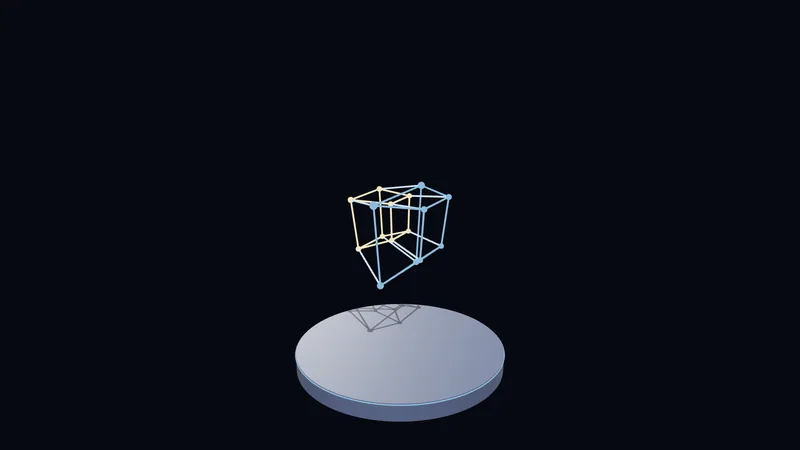
A 4D cube turns in a chosen plane and is projected into space: in an xw, yw or zw rotation the inner cube seems to turn inside out, although all 32 edges stay equally long in 4D. A true slice with the hyperplane w = c shows what a 3D being would see. Exhibit-ready: also stands on a plinth in "Knowledge as space".
Linear algebraTry it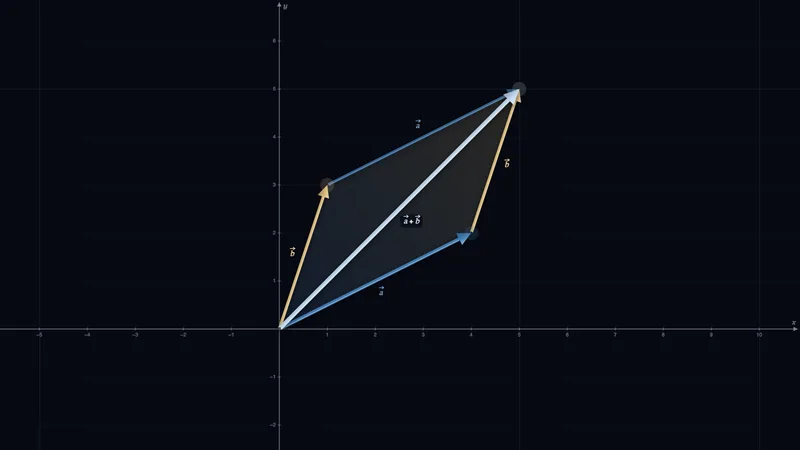
Vectors as arrows and as number pairs: shift arrows in parallel (same vector), a + b along both ways around the parallelogram, b − a and closed vector chains, multiples r·a flipping for r < 0, normalising, coordinates via e₁ and e₂ with the magnitude as Pythagoras — |a + b| ≤ |a| + |b| live.
Linear algebraTry it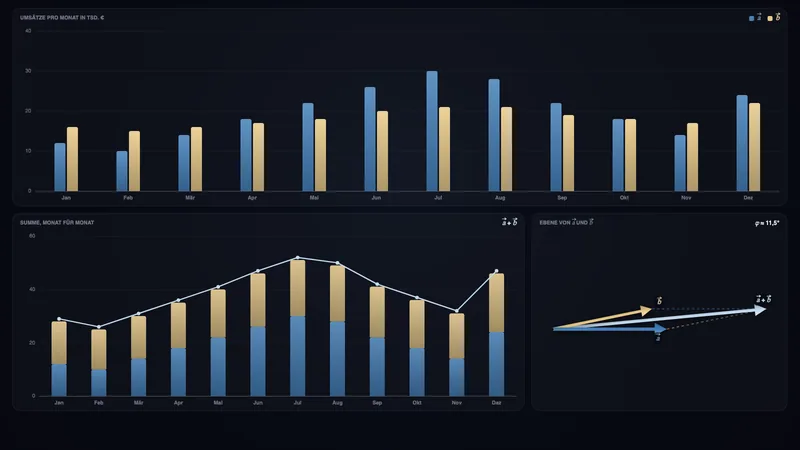
Vectors beyond arrows: monthly sales as a vector in ℝ¹², position + velocity as a state in ℝ⁶. a + b, r·a and a·b component-wise, the dot product as a running sum, magnitude and cos φ as the similarity of two curves (b = 2·a ⇒ cos φ = 1), time step position + Δt·v in 3D.
Linear algebraTry itWant to use these apps in your courses? Let’s find out what works for you.
One form, three matters. We answer personally.
We show heyprof on your own material. Tell us what you teach and we will prepare the conversation around it.