Skip to content
On this page

VisuApps

Cryptography Learn interactively.

Hash functions, keys and signatures — security you can recompute

6 VisuApps
See the apps

All subjects App catalogue

Apps

All apps. Free in your browser.

The Nonce Lottery

The Nonce Lottery

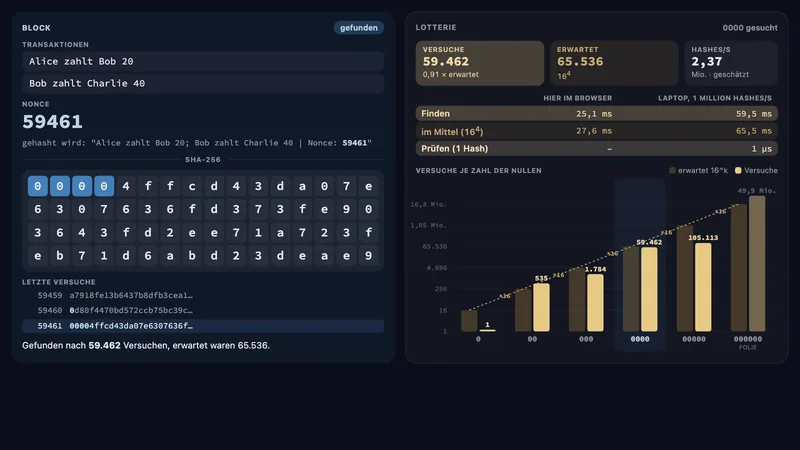
Proof of work with real SHA-256 in the browser: starting at nonce 0, a block of transactions searches for the number that makes its hash start with 1 to 5 zeros. The hash field flickers; counters set the tries against the expected 16^k, and the browser time against a laptop doing one million hashes/s. A chart shows that one more zero costs sixteen times as many tries and that each single case is a lottery. Verifying costs one hash. In chain mode, tampering with block 1 breaks the arrow to block 2.

CryptographyTry it
Hashing & collisions

Hashing & collisions

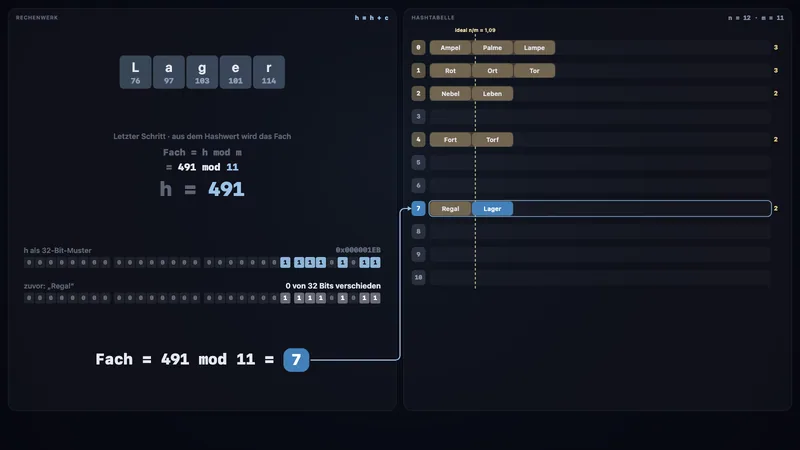
How a string becomes a table slot and how a search works: the calculator works character by character up to hash mod m. Seven methods from deliberately bad (length, first letter, character sum) to usable (polynomial hash, djb2, FNV-1a) plus the number itself. Search with a comparison counter: only one bucket is searched, while a list and a search tree need 14 and 7 instead of 3 comparisons. Growing at two thirds like dict, prime vs. power of two, statistics against the ideal.

CryptographyTry it
Pseudorandomness — how a computer rolls dice

Pseudorandomness — how a computer rolls dice

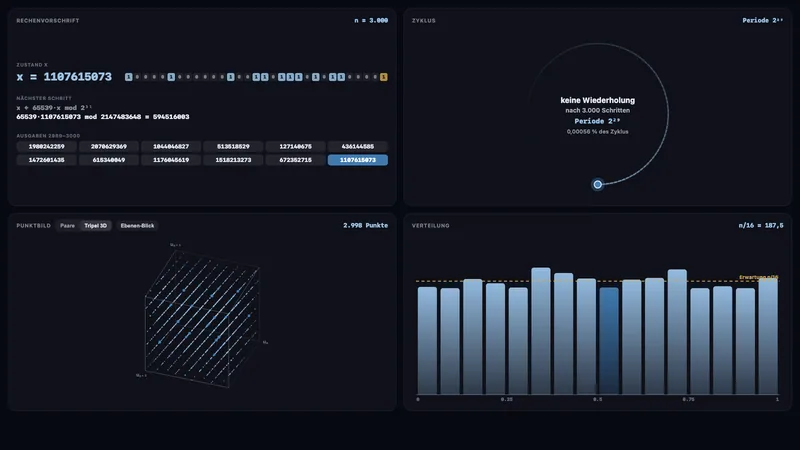
A random number generator is a fixed rule: same seed, same sequence, and eventually the loop closes. Middle-square, a linear congruential generator with freely adjustable parameters, RANDU, a shift register and xorshift side by side — good ones and deliberately bad ones. Four views reveal what a list of numbers hides: the rule with values plugged in, the cycle as a rho shape, the scatter of consecutive pairs plus a rotatable cloud of triples (RANDU collapses into 15 planes), and a histogram.

CryptographyTry it
SHA-256 in slow motion (8-bit model)

SHA-256 in slow motion (8-bit model)

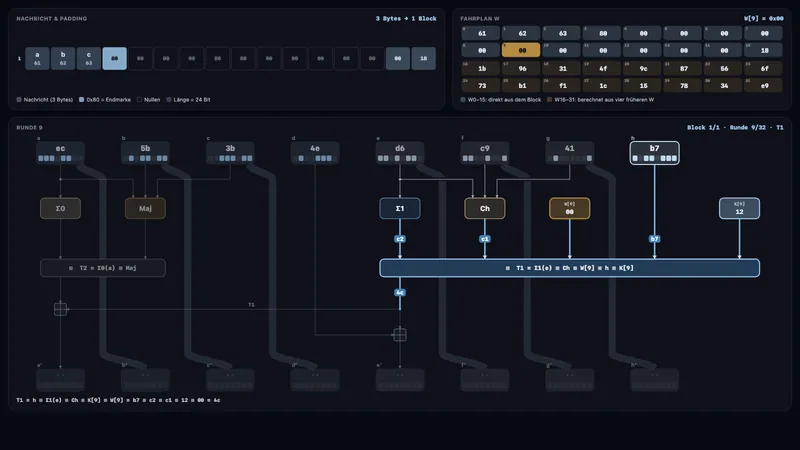
The SHA-256 compression function as a living circuit diagram: registers a to h, Ch, Maj, Σ0, Σ1 and the adders with live values on every wire, playable step by step, every operation with its bitwise calculation. The app computes a teaching model with 8-bit words and 32 rounds following exactly the rules of the original (padding, message schedule, constants from prime roots); the real SHA-256 is shown alongside. The avalanche view shows how one changed letter flips half of all bits round by round.

CryptographyTry it
Cracking a Substitution Cipher

Cracking a Substitution Cipher

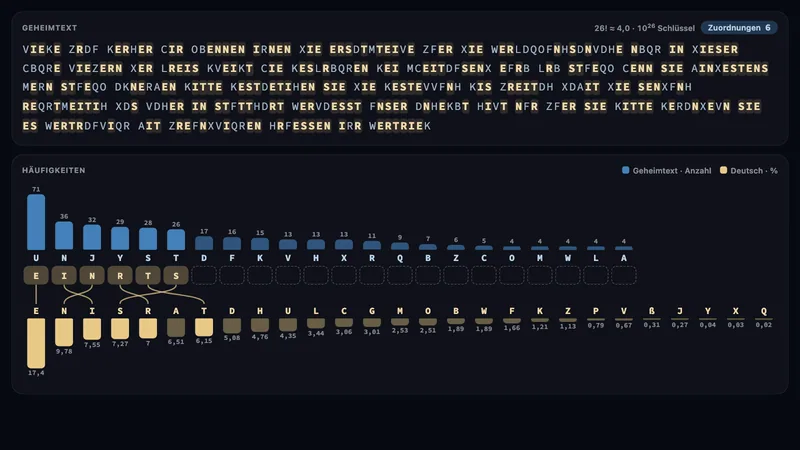
Frequency analysis, hands-on: the ciphertext sits on top, a mirror chart below. Ciphertext frequencies grow upwards, the German distribution hangs downwards, and the assignment strip lies in between. Letters are assigned by dragging or tapping, and the plaintext appears bit by bit. Three levels: Caesar with a shift slider, substitution with visible spaces, and the 27-symbol version from the slide. Despite 27! ≈ 10²⁸ keys, six assignments make SIE, IN and ES readable. With Hint and Check.

CryptographyTry it
Encrypt and Sign with Two Keys

Encrypt and Sign with Two Keys

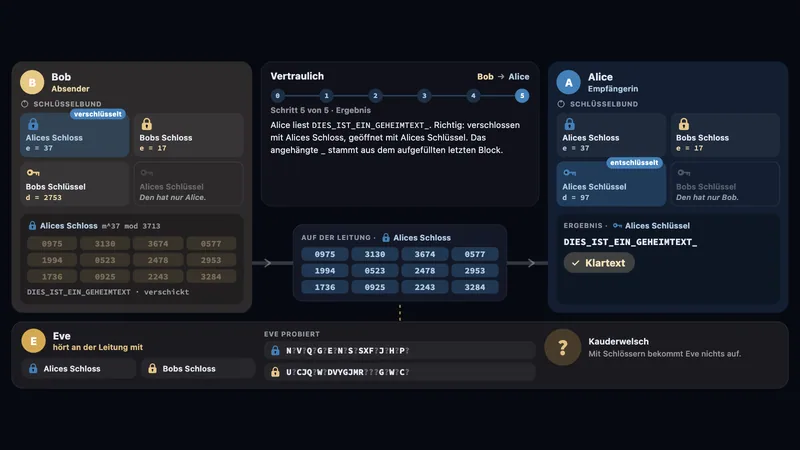
Alice, Bob and Eve with their key rings: padlocks for the public keys (everybody has all of them), keys for the private ones (only with their owner). Bob chooses what to encrypt DIES_IST_EIN_GEHEIMTEXT with, the digit card travels over the line, Eve tries every padlock. With Bob's private key Eve reads along – that is a signature, not a secret. In signed mode Alice signs an order via SHA-256, Bob checks it, Eve changes 500 to 5000 or guesses. Plus RSA with 3713 = 47 · 79 and factoring.

CryptographyTry it

New ideas for your teaching.

Want to use these apps in your courses? Let’s find out what works for you.

Tell us what this is about

One form, three matters. We answer personally.

What is this about?

We show heyprof on your own material. Tell us what you teach and we will prepare the conversation around it.

Your details

Where do you teach? (optional)

What comes back

Only when something new for your subject is ready. You will first get a mail with a confirmation link — without that click we do not add you, and we discard the address after a few days. Every later mail carries an unsubscribe link.

What happens next

  • A confirmation to your address, right away.
  • An answer from us, usually within two working days.
  • No phone call, nothing passed on to third parties.

We use your details only to answer you. Privacy policy