Psychology Learn interactively.
Memory, attention and perception in self-experiments: what we retain, what we overlook and why.
All subjects App catalogue
All apps. Free in your browser.
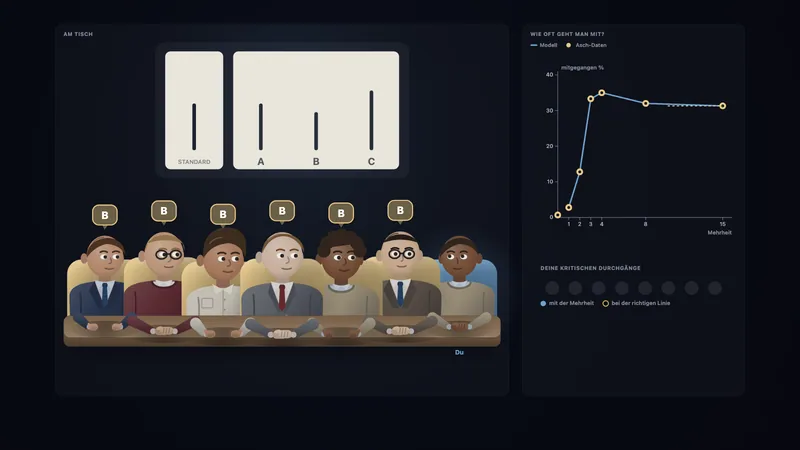
Asch lines: the majority is wrong on purpose
Self-test after Solomon Asch: six people at the table name the same wrong line unanimously in 8 of 12 trials, and you answer last. Then the reveal and a builder with Asch’s measurements: size of the majority (1 to 15), an ally who answers correctly (32 % drops to 5.5 %), answering out loud or hidden.
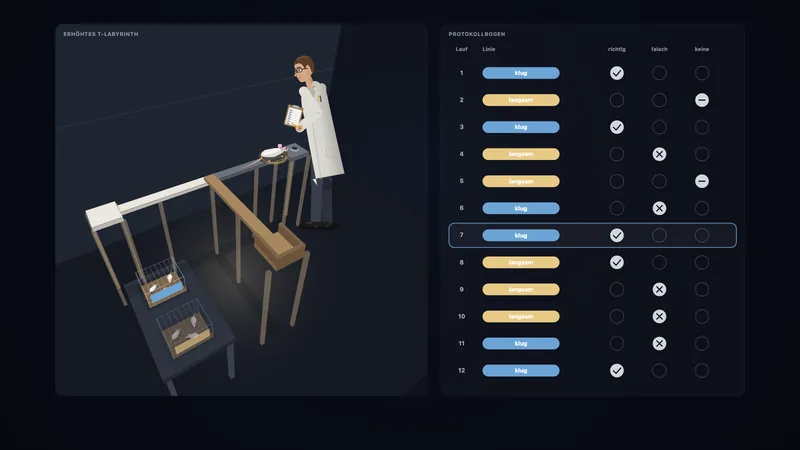
PsychologyTry itThe experimenter in the experiment
Self-test after Rosenthal and Fode (1963): you rate twelve runs of rats in an elevated T-maze, supposedly from a bright or a dull strain. The debriefing reveals six identical pairs. Plus the original data (2.32 versus 1.54 correct choices per rat per day), a model with a double-blind switch and Clever Hans from 1904.
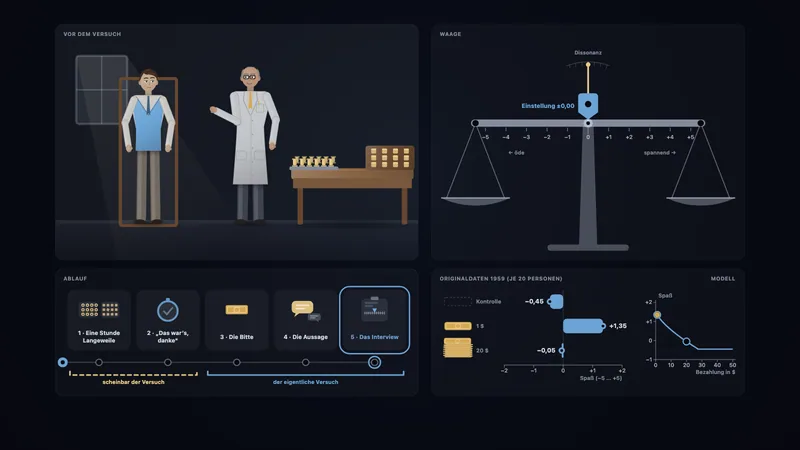
PsychologyTry itThe one-dollar lie
Festinger and Carlsmith (1959) as a scene with drawn people: an hour of spools and pegs, the apparent end, the request for $1 or $20, the statement “It’s fun” to a confederate and only then the measurement. A balance shows the dissonance, a sliding weight the attitude; plus the original data (control −0.45, $20 −0.05, $1 +1.35) and a model of payment.
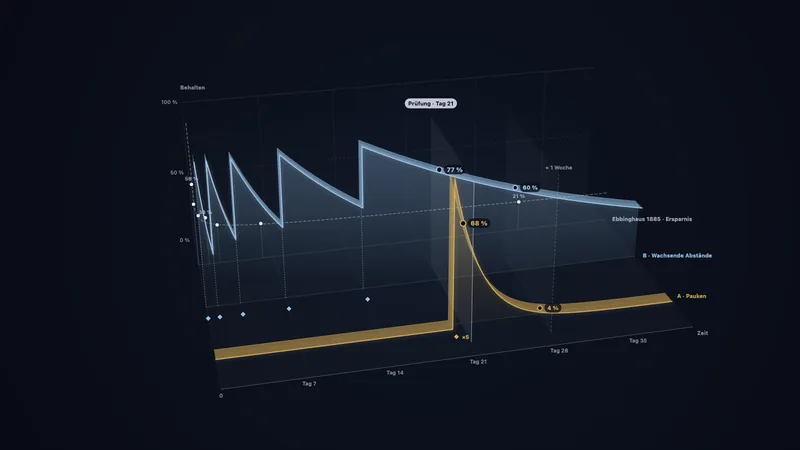
PsychologyTry itForgetting and review
Ebbinghaus’ original data from 1885 and a teaching model of the forgetting curve as ribbons over a time axis. Two study plans with the same effort compared: cramming the day before versus spaced reviews, read off on exam day and one week later. Plus a self-test with nonsense syllables.
PsychologyTry itPerception lab
Three self-experiments on selective attention: a spot-the-change task in the flicker paradigm, a counting task with an unexpected object and a letter stream showing the attentional blink. Own measurements (time to detection, noticed yes/no, hit rate per gap) appear next to literature values. Procedural 3D scenes, results stay local in the browser.
PsychologyTry itBystander effect: everyone waits, no one helps
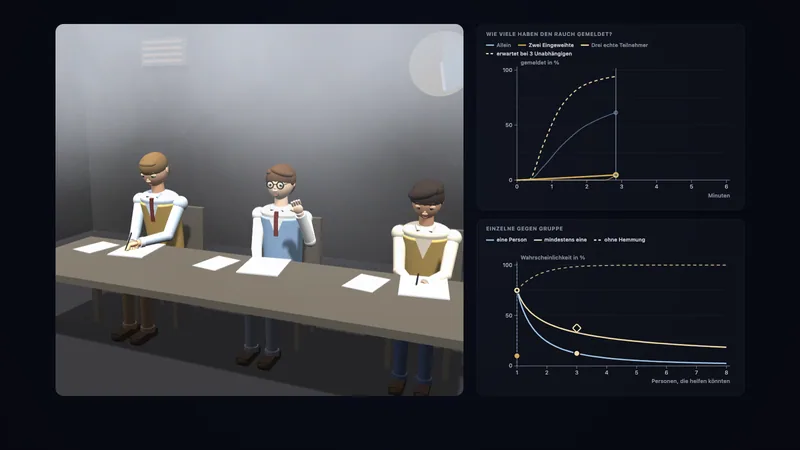
Two classic experiments by Latané and Darley in 3D: smoke enters a waiting room where a person sits alone, with two passive confederates or with two real participants; a seizure over the intercom where all other voices come from a tape. Curves with the original results (75 %, 10 %, 38 % instead of an expected 98 %) and a model showing when more bystanders even mean less help.
PsychologyTry it