Physics experiments (Deutsches Museum) Learn interactively.
Iconic exhibits of the Deutsches Museum as interactive, hands-on 3D experiments.
All subjects App catalogue
All apps. Free in your browser.
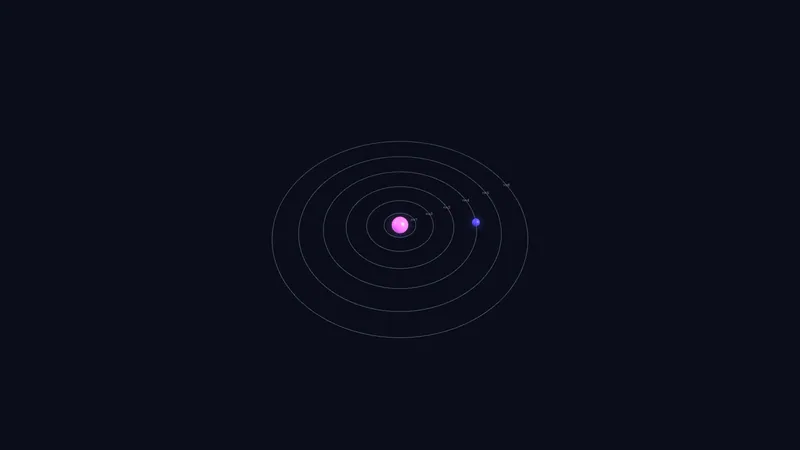
Bohr atomic model & spectral lines (3D)
The electron jumps between quantized orbits (Eₙ = −13,6 eV·Z²/n²); on a downward jump a photon is emitted and the corresponding spectral line lights up in the emission spectrum (Lyman/Balmer/Paschen). Hydrogen or He⁺.
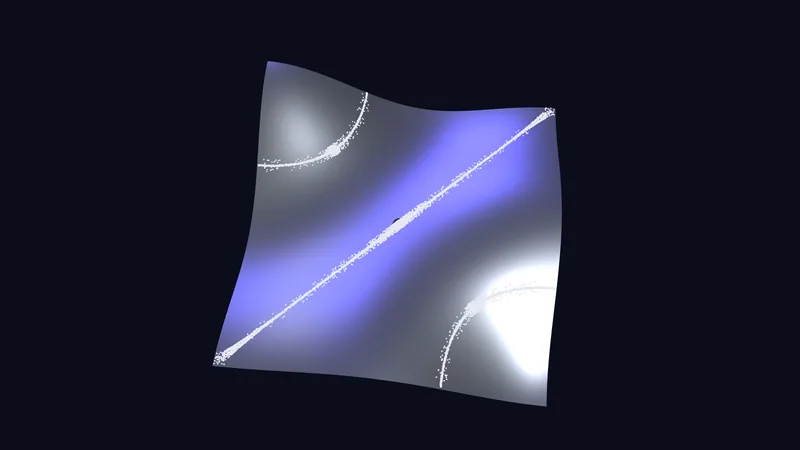
Physics experiments (Deutsches Museum)Try itChladni sound figures (3D)
Tones made visible: a vibrating metal plate (square or circle) arranges scattered sand into delicate eigenmode patterns along the nodal lines. Adjust the frequency, find resonances — finer patterns at higher modes.
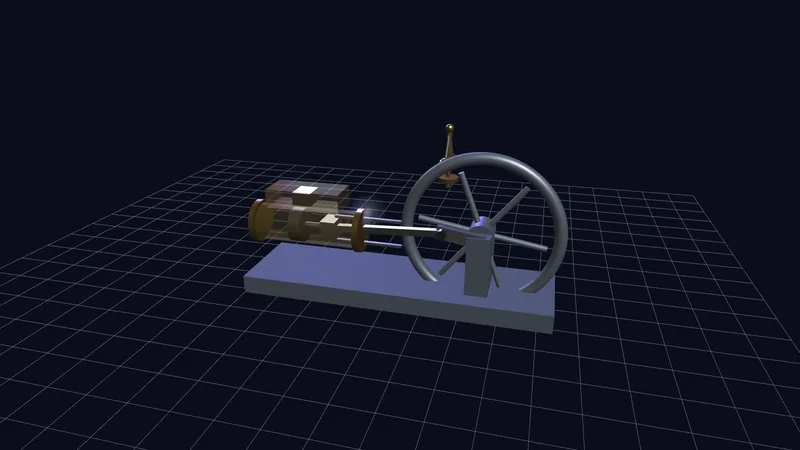
Physics experiments (Deutsches Museum)Try itSteam engine (3D)
A running cutaway model: glass cylinder with piston, crosshead, connecting rod, slide valve and a large spoked flywheel — driven via the slider crank. Steam supply and load adjustable; Watt's centrifugal governor holds the speed automatically (feedback). Steam plumes on the exhaust beat.
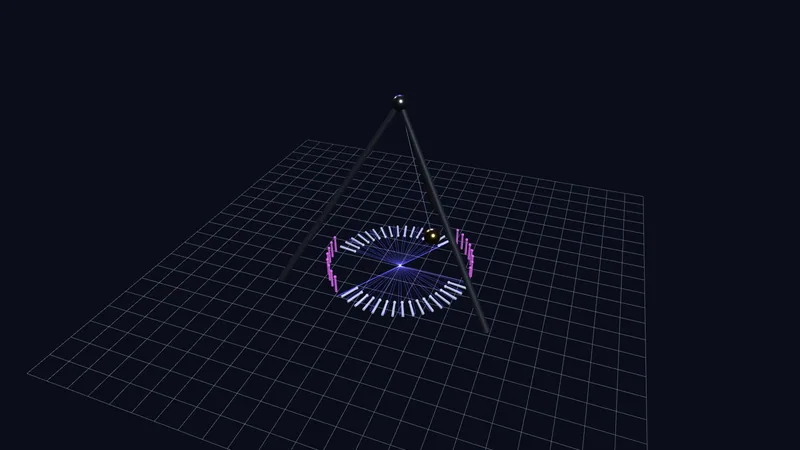
Physics experiments (Deutsches Museum)Try itFoucault pendulum (3D)
The proof of Earth's rotation: the pendulum keeps its plane of swing fixed in space while the Earth turns away beneath it. Latitude and time-lapse adjustable (15°/h · sin φ); a ring of pegs and the traced rosette make the rotation visible.
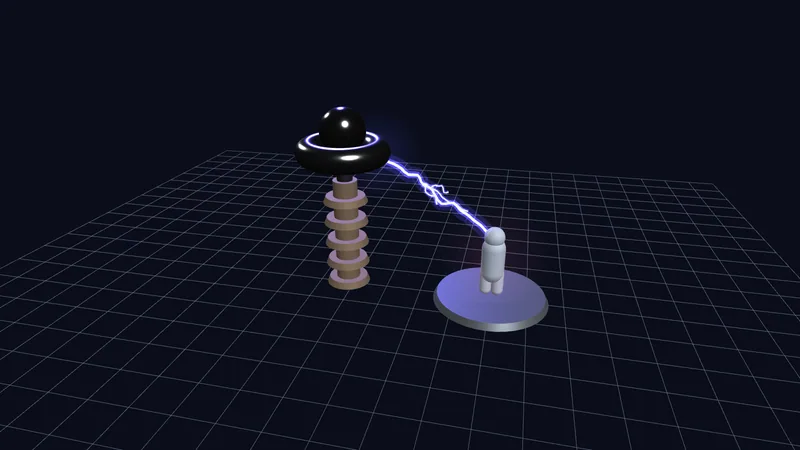
Physics experiments (Deutsches Museum)Try itHigh-voltage installation — artificial lightning (3D)
The lightning demonstration of the Deutsches Museum: a branching arc jumps from the toroid electrode. Voltage and spark gap control the breakdown (E = U/d from ~3 kV/mm); the Faraday cage protects the presenter — without the cage they get "struck".
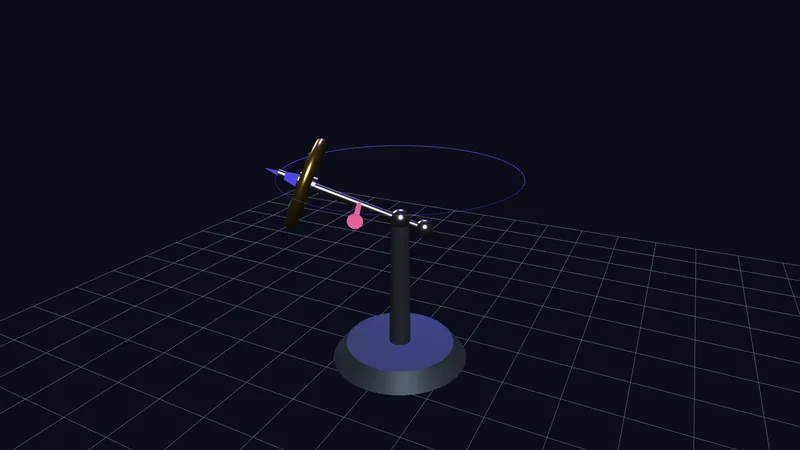
Physics experiments (Deutsches Museum)Try itSpinning top / gyroscope — precession (3D)
A fast-spinning top does not topple but precesses: gravity creates a torque τ that turns the angular momentum L sideways (Ω = m·g·r/(I·ω)). Spin and tilt adjustable, the L and τ vectors and the precession circle visible — the basis of the gyrocompass and inertial navigation.
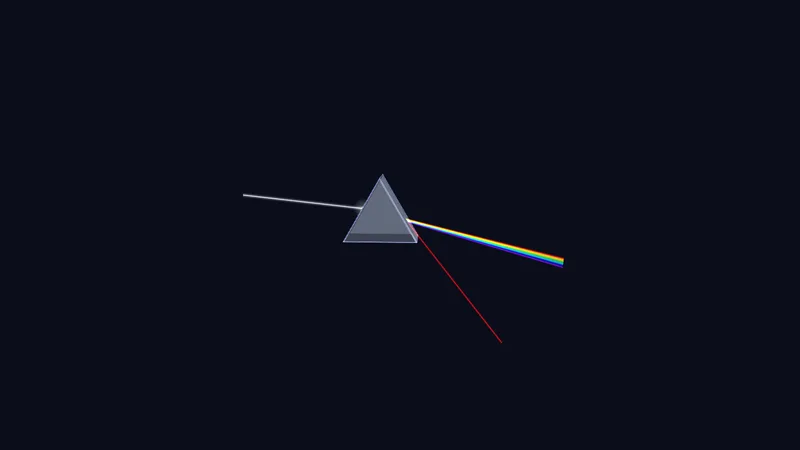
Physics experiments (Deutsches Museum)Try itNewton prism (3D)
White light splits into its colors in the glass prism — true ray tracing with Snell's refraction and a wavelength-dependent refractive index (dispersion). Material (glass/water/diamond) and angle of incidence adjustable; a second prism recombines the colors back into white.
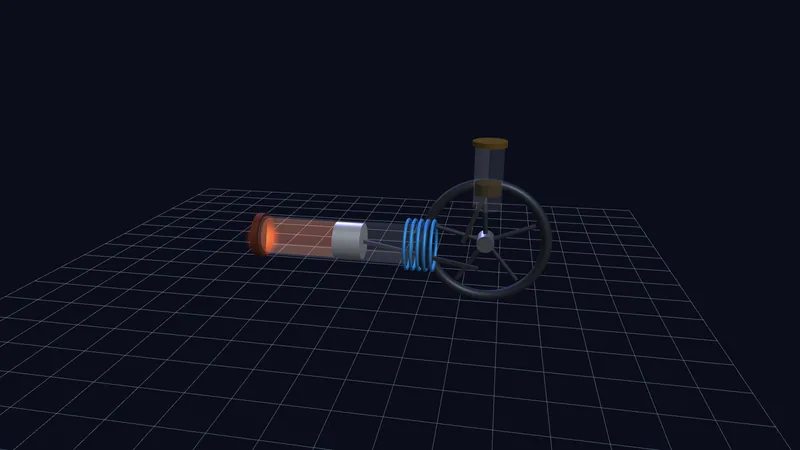
Physics experiments (Deutsches Museum)Try itStirling engine (3D)
Heat becomes motion: a running cutaway model of a Stirling engine with a hot and a cold side, displacer and power piston 90° out of phase. The gas visibly migrates between hot (glowing) and cold (cooling fins); a live p-V diagram shows the cycle. Temperature difference and speed adjustable (Carnot efficiency).
Physics experiments (Deutsches Museum)Try itWatch movement — mechanical watch with lever escapement (3D)
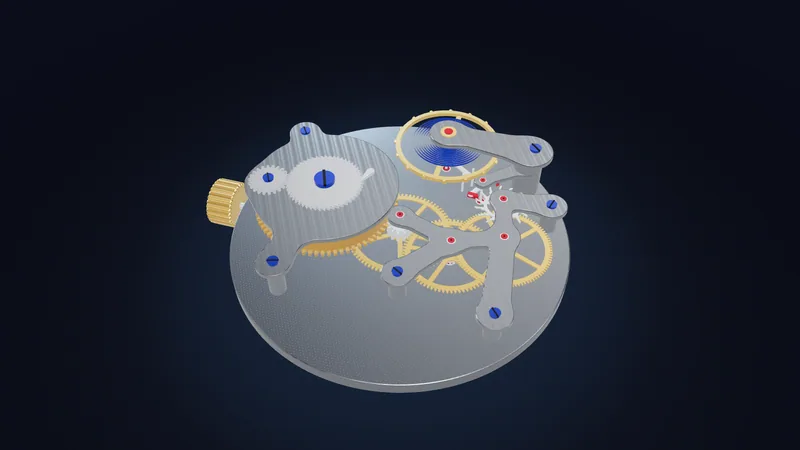
A mechanical watch movement to take apart: balance wheel and hairspring set the beat, the Swiss lever escapement releases the mainspring energy in portions. Escapement cycle in slow motion and steps, spring tension and amplitude, gear ratios with proof.
Physics experiments (Deutsches Museum)Try itWave flume (3D)
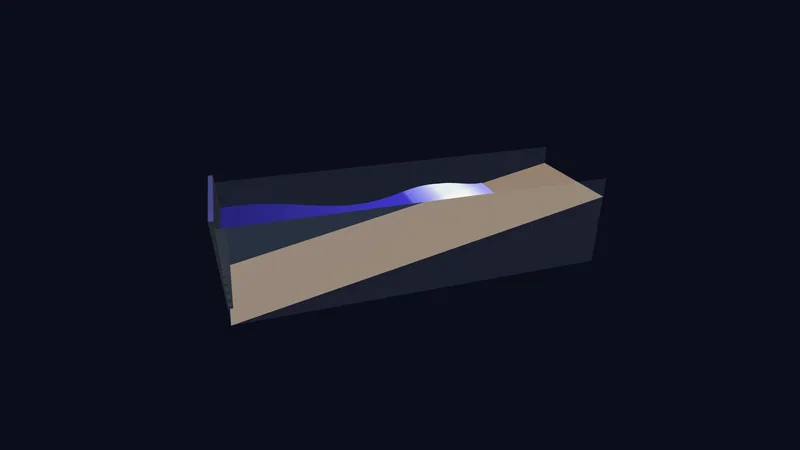
Waves on a model: a wave maker generates waves that travel over a rising bottom toward the beach. Via the dispersion relation ω²=gk·tanh(kh) they grow shorter, slower and higher in shallow water (shoaling) — until they break (surf). Wave period, amplitude and water depth adjustable.
Physics experiments (Deutsches Museum)Try itWind tunnel (3D)
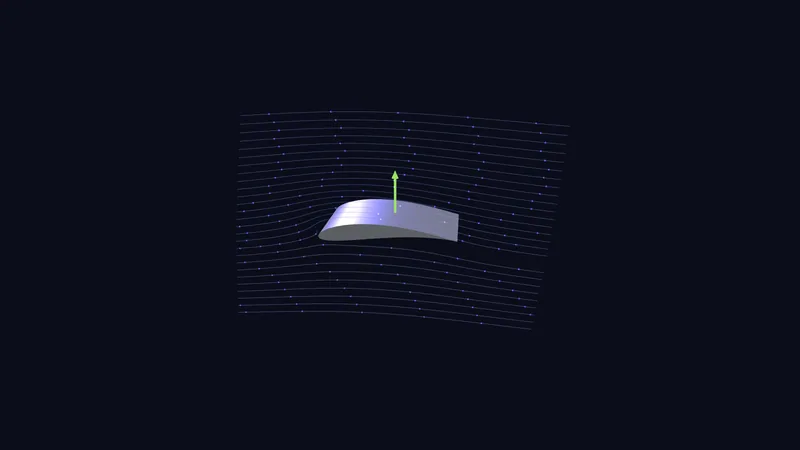
Lift made visible: smoke streamlines flow around an airfoil profile (exact Joukowski potential flow). Above the wing they crowd together — the air speeds up, the pressure drops (Bernoulli). Adjust the angle of attack up to stall, with lift coefficient and lift arrow live.
Physics experiments (Deutsches Museum)Try it